 Optoelectronics and Semiconductor Group
Assistant Professor Chih-Chien Lee
Field of study: organic
light-emitting devices, semiconductor device
physics, OLED device
simulation
Key words: OLED, device
simulation
URL: http://homepage.ntust.edu.tw/CCLEE/
Email: cclee@et.ntust.edu.tw
Phone:
886-2-27376408(voice), 886-2-27376424(Fax)
1. The
Subject and Aims of Research
Recent research
aims at studying the mechanisms of organic light-emitting devices (OLEDs) and
developing a simulation tool for OLED. It is believed that OLEDs will become the main stream technology
for next-generation flat panel displays due to their low power consumption,
high brightness, high contrast, and potentially low-cost high-performance
self-emissive display. Therefore, it is necessary to
further understand the fundamental device physics and to develop a simulation
tool. In the current
stage of OLED development, device modeling has become very helpful in that modeling accelerates the process of device optimization.
2. Related Recent Research Topics
1. Electrical and optical characteristics simulation of
OLED:
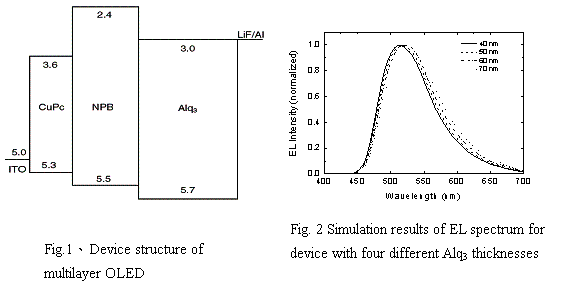
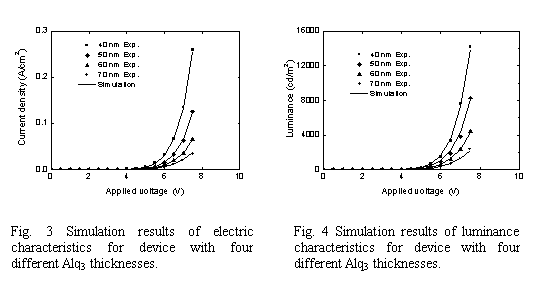
We present a numerical model for the quantitative
simulation of undoped multilayer OLEDs, which includes electrical and optical modeling together.
The electrical characteristics calculation is carried
out by using the drift-diffusion equations
that contain charge carrier drift with field-dependent mobility, charge carrier
trapping, the heterojunction interface and the recombination process, while the optical
characteristics simulation is based on material absorption and the optical
interference effect due to the refractive index discontinuities in the device.
The output of the simulation modeling proposed in this article includes the luminance, EL spectrum, CIE coordinates and I-V characteristics.






2. Electrical simulation of doping OLED:
Doped organic light emitting diode has
well-established benefits enhanced quantum efficiency. We include charge carrier trapping
and direct carrier recombination phenomena on the fluorescent dopants in the
simulation. It provides insight into the current density, charge
distribution and direct carriers recombination on the fluorescent dopant.
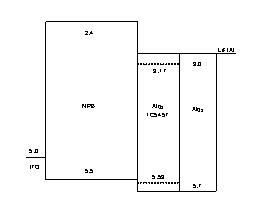
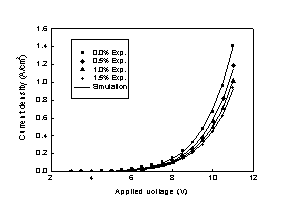

Fig. 5 Schematic energy
diagram for the doping device.
|
|

Fig. 6 J-V characteristics for devices with four
different doping ratios.
|
|

3. Selected
Publications and Projects
Publications:
1. C. C. Lee, Y. D. Jong, P. T. Huang,
Y. C. Chen, P. J. Hu and Y. Chang, “Numerical simulation of electrical model
for organic light-emitting devices with fluorescent dopant in the emitting
layer,” Japanese
Journal of Applied Physics, vol. 43, no. 11, pp. 8147-8152, 2005.
2.
C. C. Lee, M. Y. Chang, Y. D. Jong,
T. W. Huang, C. S. Chu and Y. Chang, “Numerical simulation of electrical and
optical characteristics of multilayer organic light-emitting devices,” Japanese Journal of Applied
Physics, vol.
43, no. 11A, pp. 7560-7565, 2004.